

Porcelain tile has several advantages, including very low water absorption, durability, stain resistance, and a long service life when properly selected and installed. Its disadvantages include higher upfront costs, a hard and often cold feel underfoot, greater weight, and installation that can be more difficult than standard ceramic tile.
Every flooring material comes with tradeoffs. Porcelain is no different. What matters is whether those drawbacks will actually affect the way your space is used.
International Flooring Inc. has worked with porcelain tile in commercial settings for more than 35 years. In those projects, the right choice usually comes down to traffic, maintenance, finish, installation needs, and how the floor is expected to perform over time.
In this article, we’ll break down the pros and cons of porcelain tile in practical terms, so you can make a more informed decision about whether it is the right fit for your project.
Key Takeaways
- Porcelain’s advantages: low water absorption (0.5% or less), strong resistance to scratching and staining, and a wide range of design options.
- Porcelain’s disadvantages: higher upfront cost, harder to cut and install, and a harder, colder feel underfoot than materials like vinyl or carpet.
- Not all porcelain performs the same. Slip resistance, breaking strength, and wear rating vary by product, so the label alone doesn’t tell you everything.
- Porcelain and ceramic are related but different materials. For the full technical comparison, see our guide: Porcelain vs. Ceramic Tile: What’s the Difference & Which Should You Choose.
- The right choice depends on the application; there’s no universal ranking of “best” flooring.
Porcelain Floors Pros and Cons Summary
| Pros | Cons |
|---|---|
| Water absorption of 0.5% or less | Higher upfront material and installation cost |
| Strong resistance to scratching and staining | Harder to cut, requires specialized tools |
| Suited to many high-traffic commercial spaces | Hard, unforgiving underfoot compared to softer flooring |
| Many products rated for exterior use | Can feel cold without radiant heating |
| Long service life with proper installation | Can chip or crack under sharp impact |
| Wide Range of Colors, Including Neutrals, Earth Tones, and Bold Shades | Some finishes are more slippery when wet |
| Available in Many Patterns and Looks, Including Stone, Marble, Wood, Concrete, and Terrazzo Styles | Requires a precise, flat substrate before installation to prevent cracking, bond failure, and uneven tile edges. |
| Variety of Finishes, Including Matte, Polished, Textured, and Honed | Added weight may require a structural check on upper floors |
Disadvantages of Porcelain Tiles
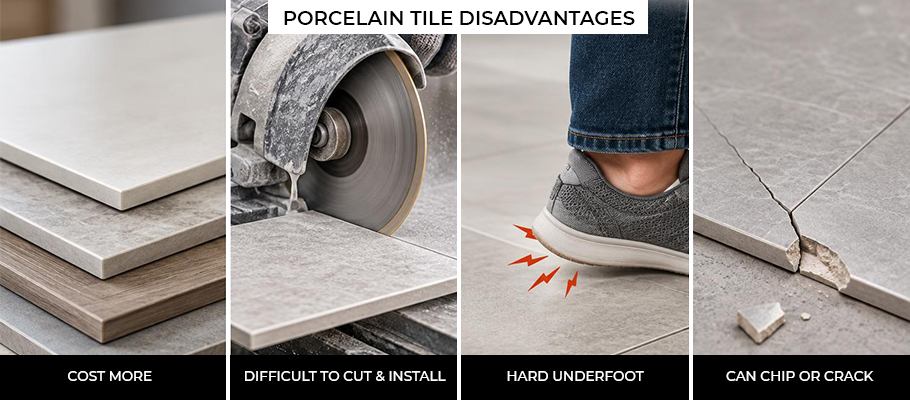
Porcelain tiles have several disadvantages, including higher upfront costs, greater weight, a hard and cold feel underfoot, and more difficult cutting and installation than standard ceramic tile. Some finishes can also become slippery when wet, and damaged tiles can be difficult to repair without replacing them.
Let’s start with the downsides, since these are usually what a buyer actually needs to plan around.
Porcelain Tile Can Cost More Upfront
Porcelain typically costs more than ceramic in both material and labor, since its density makes it harder to cut. For the full cost breakdown, see our guide: Porcelain vs. Ceramic Tile Cost: Which Is More Expensive?.
Porcelain Can Be More Difficult to Cut and Install
Porcelain’s density means it usually needs a wet saw with a diamond blade rather than a standard tile cutter, and large-format porcelain adds its own handling requirements. Thicker, larger-format tiles generally need more experienced installation, so it’s worth factoring that into which product you choose, not just how it looks.
Porcelain Floors Are Hard Underfoot
Porcelain is hard underfoot. That helps it stand up to heavy use, but it can also feel tiring if you are on your feet for hours, especially in kitchens or other busy work areas. In spots where people stand most of the day, a cushioned mat can make a noticeable difference.
Porcelain Floors Can Feel Cold
Because porcelain is dense and conducts heat well, it tends to feel cool underfoot, especially first thing in the morning. In warmer climates, that’s often a welcome trait. It’s also a natural fit for sunrooms, enclosed patios, and other glass-heavy spaces that trap heat, where a cooler floor helps balance out the sun exposure. Kitchens and entryways are another common spot people choose porcelain specifically for that cool, low-maintenance feel underfoot. If warmth matters year-round where you live, radiant floor heating is a common pairing that solves the issue without giving up the material.
Porcelain Tile Can Chip or Crack
Porcelain resists chipping and cracking better than most materials, but it isn’t immune to a hard, sharp impact, especially at an exposed edge or corner. Repairs can also be tricky: a chip or crack often means replacing the whole tile rather than patching it, since color-matching a repair on a large or discontinued product isn’t always possible. For the full technical picture on breaking strength and what actually causes cracking, see our guide: Is Porcelain Tile Durable? Strength, Hardness, Porosity & Heat Resistance.
Some Porcelain Tile Can Be Slippery
Porcelain tile can become more slippery when it has a smooth, glossy, or polished finish and is exposed to water, soap, oils, grease, or other contaminants. Slip resistance varies by product, surface texture, conditions, and maintenance, so the manufacturer’s recommended area of use and slip-resistance data should always be checked.
For porcelain floor tile, slip resistance should be checked on the specific product rather than assumed from the material alone. DCOF, or Dynamic Coefficient of Friction, is one measure used to evaluate hard flooring surfaces. Under ANSI A326.3, porcelain tile classified for Interior Wet (IW) applications generally has a wet DCOF of 0.42 or greater, although some products may be manufacturer-declared for the intended use.
Slip resistance matters most where water is likely to end up on the floor, such as bathrooms, pool decks, rainy entryways, and commercial kitchens. In a dry bedroom or living room, it is usually less of a concern.
Porcelain can still be a good choice. The important part is matching the finish to where it will be used. Matte and textured surfaces usually offer more grip than polished tile, but the product’s DCOF rating and manufacturer recommendations should guide the final decision.
Grout Still Requires Cleaning and Maintenance
The tile itself resists moisture well, but grout is a separate, more porous material, and it’s usually the first thing to show wear. Grout needs regular cleaning to prevent staining and discoloration, and full regrouting typically isn’t needed for 8 to 15 years, regardless of how well the surrounding porcelain is holding up.
Porcelain and Grout May Require Sealing
Porcelain itself usually does not need sealing. Because it absorbs so little water, most porcelain products can be installed without it. Certain polished finishes are an exception, and some manufacturers recommend applying a sealer before grouting.
Grout is different. Most cement-based grout benefits from being resealed every 1 to 2 years. In high-moisture areas, such as showers, that may need to happen more often, sometimes every 6 to 12 months.
Epoxy grout is the exception. It is non-porous and does not need to be sealed.
Subfloor Prep Has to Be Precise
Porcelain tile needs a flat, stable surface underneath it. If the subfloor is uneven, cracked, or moving, the finished floor can develop problems such as uneven tile edges, poor support, or cracking over time.
This becomes even more important with large-format tile. ANSI A108.02 allows no more than 1/8 inch of variation over 10 feet, with no more than 1/16 inch of variation within any 24-inch span, for tile with at least one edge 15 inches or longer. That is why careful subfloor preparation is an important part of a successful porcelain tile installation.
Porcelain Tile Is Heavy
Porcelain is dense, and that also makes it heavy. On upper floors or large commercial projects, the added weight can matter, so it is worth checking the building’s structural load limits before choosing the material.

Advantages of Porcelain Tile
Porcelain tile offers several real advantages, including high durability, very low water absorption, and strong resistance to stains. It’s available in a wide range of colors, patterns, and finishes, and performs well in both residential and commercial spaces, including many exterior applications.
Porcelain Tile Is Durable and Long-Lasting
Porcelain’s density translates into measurable performance. Commercial-grade porcelain commonly carries a PEI rating of 4 or 5, the industry’s wear-resistance scale, and has to meet a minimum breaking strength under ANSI A137.1. That’s the kind of thing you’ll find on the product’s actual technical data sheet. When properly installed, that combination of density, hardness, and breaking strength adds up to a floor built to hold up over years of real use. For the full technical breakdown on hardness, breaking strength, and what actually causes wear over time, see our guide: Is Porcelain Tile Durable? Strength, Hardness, Porosity & Heat Resistance.
Porcelain Has Very Low Water Absorption
Porcelain tile has a water absorption rate of 0.5% or less, which earns it the “impervious” classification, the tile industry’s term for the lowest, most water-resistant tier under the ANSI water absorption scale. Very little moisture actually gets into the tile itself. That’s a big part of why it holds up well in kitchens, entryways, and other spaces where moisture is a regular concern.
Porcelain Tile Resists Stains and Is Easy to Maintain
Because so little moisture gets into the tile itself, spills and everyday grime tend to sit on the surface instead of soaking in. Daily cleanup is simple: sweep or vacuum first to keep grit from scratching the surface, then mop with a pH-neutral cleaner, avoiding bleach, ammonia, or harsh acids that can damage the glaze or grout over time. That resistance holds up well over years of use, not just when the floor is new.
Porcelain Comes in Many Colors, Patterns, Sizes, and Finishes

Porcelain isn’t a one-look material. It’s available in a genuinely wide range of colors, patterns, sizes, and finishes, from small mosaics to large-format slabs, so it can fit almost any design direction without giving up performance.
| Category | Common Options |
|---|---|
| Colors | Neutrals (white, beige, gray, black), earth tones, and bold or vibrant shades |
| Patterns and looks | Solid and minimalist, realistic stone, marble, wood, and concrete looks, geometric patterns like hexagon and herringbone |
| Sizes | Small format (mosaics, 2×2″ to 6×6″) for detail work, standard sizes like 12×24″ and 24×24″, and large-format tile or slabs (15″ and larger per ANSI A137.1) for a more seamless look with fewer grout lines |
| Finishes | Matte, polished, textured, and honed |
Large-format tile and slabs come with their own thickness and installation requirements.
Porcelain Tile Works Well in Many Residential Spaces
Porcelain is a good fit for busy homes because there is nowhere for dust, pet dander, or pollen to hide. Unlike carpet, it has no fibers to hold onto those particles.
In kitchens, entryways, and other high-use areas, that makes everyday cleanup simpler. Dirt stays on the surface, where it can be swept or mopped away.
Porcelain Tile Works Well in Many Commercial Spaces
Porcelain is often used in hotels, healthcare facilities, and retail spaces because it can handle heavy traffic and frequent cleaning without showing wear too quickly.
IFI has used porcelain tile in patient bathrooms and public areas at Health Central Park Nursing & Rehab, where wheelchairs, foot traffic, and daily cleaning are part of the routine. It was also installed in guest bathrooms at Evermore Flats Resort, where housekeeping cleans the floors between stays.
The settings are different, but the need is similar. The floor has to keep up with daily use and still hold its appearance over time.
Some Porcelain Tile Is Suitable for Exterior Applications
Porcelain’s low water absorption and fired-in color make it a strong option for patios, pool decks, and other exterior applications, provided the specific product is manufacturer-rated for outdoor use. Because porcelain’s color is fired into the material rather than applied as a surface coating, it resists UV fading in a way painted or dyed surfaces don’t.
That exterior rating should cover more than UV exposure. Wet areas such as pool decks usually need stronger slip resistance than interior floors under ANSI A326.3, and in colder climates, freeze-thaw testing under ASTM C1026 may matter too.
Thickness is another factor. Exterior porcelain is often made thicker, sometimes up to 20 mm for paver or pedestal systems, so it can handle heavier foot traffic and concentrated loads.

Is Porcelain Tile Slippery?
It depends on the finish and where it’s used. Smooth, high-gloss, or polished porcelain can become slippery when wet, while textured or matte finishes generally test higher for slip resistance. Per ANSI A326.3, tile intended for wet interior floors should carry a wet DCOF (Dynamic Coefficient of Friction) rating of 0.42 or greater, though DCOF alone doesn’t guarantee a surface won’t ever be slippery.
That last point is worth sitting with for a second: the Tile Council of North America itself states that DCOF is useful for comparing surfaces, but it can’t predict whether any specific person will or won’t slip on a given floor. A number on a spec sheet is a helpful comparison tool, not a safety guarantee.
Is Polished Porcelain Tile Slippery?
Generally, yes, more so than a matte or textured finish. Polishing creates a smoother, more reflective surface, which offers less microscopic texture for grip, especially when wet. That doesn’t mean every polished product fails to meet the 0.42 wet DCOF minimum; some are specifically formulated to hold traction despite the shine, but it does mean the finish alone isn’t something to assume is safe for a wet area without checking the actual rating.
What Determines Porcelain Tile Slip Resistance?
Finish is only one factor. Grout joint width and texture affect measured slip resistance too, smooth, rectified tile with tight joints sometimes needs added surface texturing to meet the threshold that a wider, more textured joint would help with naturally. Where the tile is going matters as much as the tile itself: ANSI A326.3 classifies use conditions into separate categories, Interior Dry, Interior Wet, Interior Wet Plus, Exterior Wet, and Oils/Greases, each with its own minimum DCOF. Pool decks fall under the stricter Exterior Wet classification, calling for a wet DCOF of up to 0.55, higher than the 0.42 minimum for a standard interior wet floor.
A tile that works well on a bathroom floor may still be the wrong choice for a pool deck. That is why the product’s use classification matters, not just a single slip-resistance number.
Commercial kitchens are another case entirely. Grease underfoot creates a different kind of slip risk than water. And even a tile that performs well when new can lose traction over time if cleaning residue or product buildup is left on the surface.
Matching the right classification to the right space is exactly what IFI’s Design Assist & Preconstruction process is built to catch, before a single tile goes down, not after.
How to Compare Slip Resistance Before Choosing Porcelain Tile
When you’re comparing products, ask for the tile’s DCOF rating and whether it’s rated for the space you’re using it in: wet interior, exterior, or a pool deck.
A few simple checks can help when you are comparing tile on your own:
- Matte and textured finishes usually give you more traction than polished or glossy tile, especially in areas that get wet.
- If a tile is sold for showers, bathrooms, or outdoor spaces, that is a good sign, but still check the manufacturer’s slip-resistance rating.
- In higher-risk areas such as pool decks, commercial kitchens, or hotel entrances, do not judge by the finish alone. Look at the actual DCOF rating for the product.
For readers who do want to see what real documentation looks like, here’s an example from two actual manufacturer spec sheets:
| Product Example | Wet DCOF | Notes |
|---|---|---|
| Shaw Eminent Notion, glazed porcelain | 0.42 or greater | Meets the ANSI A326.3 Interior Wet minimum |
| Daltile StepWise line | 0.60 or greater | Rated for both indoor and outdoor use |
Matching the rating to the actual space matters more than picking the highest number available. A 0.42-rated product is appropriate for a standard interior wet area; a pool deck or commercial kitchen may call for something closer to the StepWise example above.
Is Porcelain Tile Expensive?
Yes, porcelain typically costs more upfront than ceramic tile or vinyl, both in materials and installation labor. But it usually costs about the same as, or less than, natural stone or hardwood, and its low maintenance and long service life often make it the better long-term value once you factor in what you’d spend replacing a cheaper floor sooner.

Is Porcelain Tile Right for Your Space?
It depends on your priorities. Porcelain is a strong choice when durability, moisture resistance, and low long-term maintenance matter more than upfront cost or a soft underfoot feel, common in kitchens, entryways, bathrooms, and high-traffic commercial spaces. For softer comfort, lower budgets, or spaces with a difficult subfloor, another material may be the better fit.
When Porcelain Tile Is a Good Choice
Porcelain works well in spaces that need a tough, low-maintenance floor and can justify the higher upfront cost. Kitchens, bathrooms, entryways, and busy commercial areas are common examples.
IFI has installed porcelain throughout Central Florida for more than 35 years, including hospitality and healthcare projects where floors see constant traffic and frequent cleaning. As an NTCA Five-Star Accredited Contractor, the team works with porcelain in the kinds of spaces where its durability and low water absorption matter most.
When Another Flooring Material May Be a Better Fit
Porcelain is not always the best answer. If comfort matters most, such as in a nursery, home office, or a room where people stand for hours, vinyl or carpet may feel better underfoot.
It may also be more flooring than the space really needs. In lower-traffic areas with little moisture, a less expensive material can make more sense. And if the subfloor cannot be leveled enough for porcelain, choosing a more forgiving option may save time and money.
| Flooring Priority | Is Porcelain A Good Fit |
|---|---|
| Heavy traffic and long-term durability | Yes, porcelain is a good fit |
| Moisture resistance (kitchens, entryways, wet areas) | Yes, porcelain is a good fit |
| Soft, warm feel underfoot | Porcelain is not the best fit |
| Lowest possible upfront cost | Worth comparing against ceramic |
| A quick, simple DIY installation | Worth comparing against easier-to-install materials |
The Most Common Mistake When Choosing Porcelain
One of the easiest mistakes to make is choosing porcelain based on appearance alone. A tile may look perfect in a showroom and still have the wrong PEI rating for a busy commercial hallway or too little slip resistance for a wet entryway.
“Porcelain” tells you what type of tile you are looking at, but it does not tell you how that specific product will perform. For that, you still need to check its PEI rating, DCOF, and other manufacturer specifications.
Conclusion
Porcelain has earned its reputation for good reason. It absorbs very little water, meets clear durability standards, and comes in a wide range of styles that can hold up well over time.
That does not mean porcelain is the best fit for every space. It can cost more upfront, feel hard underfoot, and demand more from the installation team. Those trade-offs are worth considering before you commit to it.
The better approach is to look at the exact product, including its PEI rating, DCOF, breaking strength, and manufacturer recommendations. The porcelain label tells you part of the story. The rest comes down to whether that specific tile fits the traffic, moisture, and daily use of the space.
Ready to figure out if porcelain is the right fit for your project?
For over 35 years, International Flooring Inc. has helped Central Florida businesses navigate exactly this decision, matching the right product to commercial spaces where getting it right the first time matters. As an NTCA Five-Star Accredited Contractor, IFI brings that same level of scrutiny to every project, from Design Assist & Preconstruction through final installation.
Request a free, no-obligation estimate by filling out our contact form or calling (407) 296-7465.
References
ANSI A326.3: Test Method for Dynamic Coefficient of Friction of Hard Surface Flooring Materials — ANSI Webstore (free)
https://webstore.ansi.org/standards/tca/ansia3262021
Dynamic Coefficient of Friction, Frequently Asked Questions — Tile Council of North America
https://tcnatile.com/dynamic-coefficient-of-friction-frequently-asked-questions/
DCOF Slip Resistance Testing, Reading Test Results — Daltile
https://www.daltile.com/why-daltile/industry-standards/dcof-slip-resistance-testing-reading-test-results
Eminent Notion Technical Sell Sheet (DCOF, Breaking Strength, Water Absorption) — Shaw Contract
https://cdn.shopify.com/s/files/1/1996/7489/files/Shaw_Tile_Eminent_Notion_Sell_Sheet.pdf
Walking-Working Surfaces Final Rule, Frequently Asked Questions — U.S. Department of Labor, OSHA
https://www.osha.gov/walking-working-surfaces/faq
ANSI Standards for Ceramic and Porcelain Tile (A108, A137.1, A137.3) — Tile Council of North America
https://tcnatile.com/resource-center/ansi-standards/