
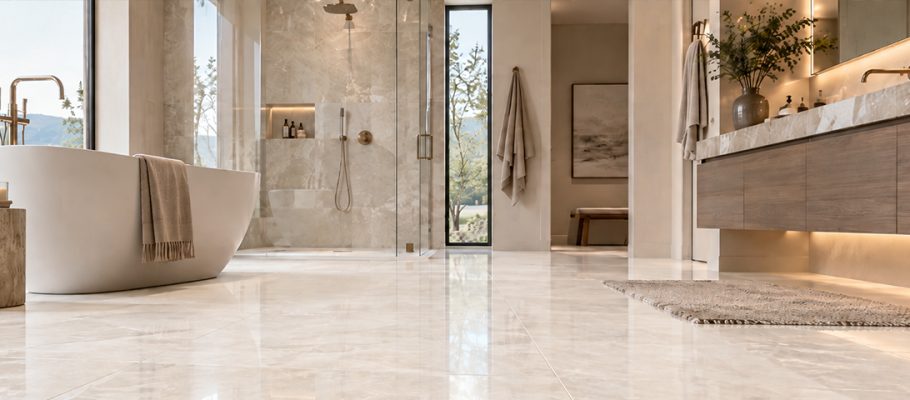
Porcelain is a type of ceramic tile with a water absorption rate of 0.5% or less. It is generally denser and less porous than ceramic tile, making it well suited for many high-traffic and moisture-prone applications. Ceramic tile generally costs less and is easier to cut, making it practical for many walls, backsplashes, and appropriately rated floors.
Choosing between porcelain and ceramic tile is a common question for business owners and homeowners weighing the best flooring option for their space. Selecting between porcelain or ceramic tile depends on:
- How and where the tile will be used
- The level of moisture exposure
- Traffic demands
- Budget
- Indoor or outdoor use
- Long-term performance expectations
Understanding these differences can help you avoid costly mistakes and select a tile that meets the functional and design goals of your project.
Please Note: Per the Tile Council of North America (TCNA), porcelain is technically a type of ceramic tile, not a separate material, defined specifically by that 0.5% or lower water absorption rate. In this article, when we use “ceramic tile,” we mean “non-porcelain ceramic tile,” which is how the term is commonly used when comparing ceramic and porcelain products.
Key Takeaways
- Porcelain is a type of ceramic tile characterized by a water absorption rate of 0.5% or less.
- Porcelain is generally denser and less porous than ceramic tile.
- Porcelain is well suited for many high-traffic, wet, and demanding applications, but the specific product must still be appropriate for its intended use.
- Ceramic tile can be a practical, durable, and cost-effective choice for walls, backsplashes, and appropriately rated floors.
- Porcelain is typically more expensive and can be more demanding to cut and install.
- Choosing between porcelain or ceramic tile should be based on the application, moisture exposure, traffic, product specifications, and budget, not simply the material name.
Porcelain or Ceramic Tile Summary
Here’s a side-by-side look at how porcelain and ceramic tile compare across the factors that matter most for choosing the right material.
| FEATURE | PORCELAIN TILE | CERAMIC TILE |
|---|---|---|
| Material Family | Type of ceramic tile | Ceramic tile |
| Water Absorption | 0.5% or less | More than 0.5%, varies by tile type |
| Density & Porosity | Density typically 2.3 to 2.5 g/cm³ (2,300-2,500 kg/m³). Water absorption under 0.5%, classified as impervious. Highly frost resistant due to minimal internal porosity. | Density is generally lower than porcelain and varies by product. Water absorption typically 3.0% to 7.0% or more, classified as semi-vitreous to non-vitreous. More prone to moisture absorption if the surface glaze is compromised. |
| Durability | Commonly available in PEI 4 (heavy traffic) to PEI 5 (extra-heavy traffic), suited to commercial floors, retail, and high-traffic entryways | Commonly available in PEI 1-3 (light residential to light commercial); PEI 4-5 ceramic exists but is less common than in porcelain |
| Moisture Exposure | Rated for wet areas, showers, and exterior use when the specific product carries manufacturer frost-resistant certification | Suitable for dry-to-light-moisture interior areas; wet-area or exterior use requires a product specifically rated for that exposure |
| Best Uses | High-traffic floors, wet areas, commercial spaces, and many exterior applications | Walls, backsplashes, and appropriately rated residential or commercial floors |
| Material Cost | Generally higher material and installation cost, driven by denser raw materials and more demanding fabrication | Generally lower material and installation cost, due to simpler manufacturing and easier on-site cutting |
| Installation | Porcelain typically requires a wet saw with a diamond blade due to density | Ceramic can often be cut with a manual tile cutter or nippers |
| Design Options | Available in large-format tiles and gauged slabs; offers through-body color options where pattern runs through the full tile thickness | Widely available in standard tile sizes; typically decorated via surface glaze rather than through-body color |
| Outdoor Use | Often suitable for exterior use; verify manufacturer exterior rating, UV fade resistance, freeze-thaw resistance where needed, and wet slip resistance. | Must be specifically rated by the manufacturer for exterior use; standard indoor ceramic should not be assumed suitable outdoors. |
| Maintenance | Low-maintenance due to inherent density; unglazed/through-body products don’t rely on a surface coating for stain resistance | Low-maintenance when glazed; stain resistance depends on the glaze layer remaining intact |
| How to Identify | Data sheet: Check the data sheet for “impervious” or 0.5% or less water absorption. No Data sheet: Porcelain feels heavier for its size and often has a light gray, white, or cream body visible on an unglazed edge. | Data sheet: Check the data sheet for “vitreous,” “semi-vitreous,” “non-vitreous,” or absorption above 0.5%. No Data sheet: Ceramic tends to feel lighter and often shows red, brown, or tan clay on an unglazed edge. |
What’s Better Porcelain or Ceramic Tile
Neither porcelain nor ceramic tile is universally better. Porcelain is generally denser, has a water absorption rate of 0.5% or less, and is well suited for many high-traffic and moisture-prone applications. Ceramic tile is generally more affordable and easier to cut. The better choice depends on the application, traffic, moisture exposure, and budget.
Here’s how it typically shakes out by application:
| Project Type | Typically Better Fit | Why |
|---|---|---|
| High-traffic commercial floor | Porcelain | Higher PEI ratings (4-5) hold up to heavy foot traffic |
| Wet area or exterior installation | Porcelain | Water absorption of 0.5% or less |
| Budget-conscious wall or backsplash | Ceramic | Lower material cost, easier on-site cutting |
| Light-traffic residential floor | Either, if properly rated | Both perform well when the product matches the application |
Difference Between Ceramic and Porcelain
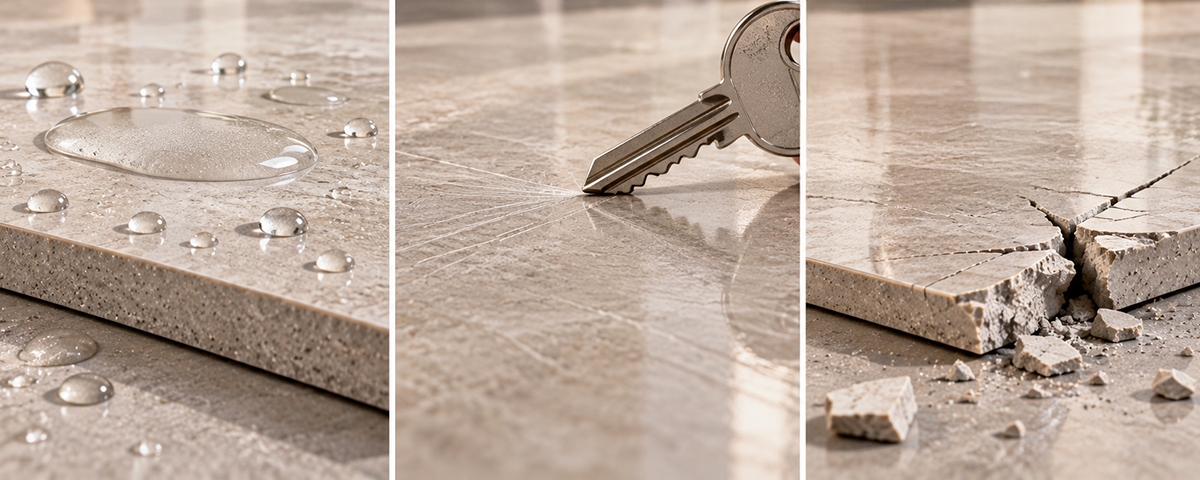
Porcelain and ceramic differ in more than name. The way each tile is made affects its hardness, water resistance, chip resistance, installation, and cost. Those differences become more noticeable once you look at how each material performs in everyday use.
Is Ceramic the Same as Porcelain?
No. Porcelain is a subcategory of ceramic tile, not a separate material. The two get used interchangeably in everyday conversation, but on a spec sheet they’re classified differently; see the comparison table above for the exact breakdown.
The confusion also shows up in how tile is marketed. Some manufacturers use “porcelain” for premium collections and “ceramic” for more standard lines, even though the real difference comes down to technical specs such as water absorption.
The label only tells you so much. If the tile is going in a wet area, outdoors, or anywhere the 0.5% absorption limit matters, check the technical data sheet before choosing it.
How to Tell Difference Between Ceramic and Porcelain Tile?
The most reliable way to tell them apart is to check the technical data sheet for the water absorption rate. A rating of 0.5% or lower means you’re looking at porcelain. Anything higher is standard ceramic.
If you don’t have a technical data sheet, a few simple clues can help on site. Porcelain often feels heavier than ceramic for the same size tile because it is denser. When tapped, it may also produce a slightly sharper, higher-pitched sound.
Inspecting the Color and Bisque (Back/Edge)
- Porcelain: The side and back body (bisque) is usually a consistent light color, white, gray, or cream. True through-body porcelain carries that same color all the way through the tile, though many modern porcelain products are still top-glazed rather than through-body.
- Ceramic: The unglazed back or edge is frequently red, brown, or tan clay, noticeably different from the finished top surface.
None of these tricks replace checking the actual product specifications, but they can help you get a quick read on what you’re holding.
Ceramic Tiles or Porcelain Tiles Advantages
Each material brings its own strengths to the table. Here’s a closer look at what ceramic and porcelain each do best.
Advantages of Ceramic Tile
Ceramic tile is valued for its affordability, extensive design options, and relative ease of cutting and installation. It can work well for walls, backsplashes, and floor applications when the specific tile is rated for the intended use.
A few benefits of ceramic tile tend to get overlooked. It handles heat well, which is why you often see it around fireplaces and wood-burning stoves. Glazed tile also does not hold onto odors easily, a useful feature in restaurants, clinics, and other spaces that need frequent cleaning. In warm climates, like Florida, it has another simple advantage: it usually feels cooler underfoot than carpet or vinyl.
Advantages of Porcelain
Porcelain tile has a water absorption rate of 0.5% or less and is generally denser than ceramic tile. These characteristics make porcelain particularly useful for many high-traffic, moisture-prone, and demanding applications.
Porcelain has a few practical benefits that are easy to overlook. Because it absorbs very little moisture, it is less likely to support mold, mildew, or bacteria than more porous flooring materials. That can be especially useful in healthcare and food service settings.
It also stands up well to grease, acids, and strong cleaning products, which helps explain why porcelain is so common in commercial kitchens.
Ceramic Tile and Porcelain Tile Advantages Summary
Here’s a side-by-side look at where each material has the edge, so you can match the right one to your project.
| Pros of Ceramic Tile | Pros of Porcelain Tile |
|---|---|
| Generally more affordable than porcelain, in both material and installation cost | Water absorption of 0.5% or less, classified as impervious |
| Easier to cut and install without specialized equipment | Resists mold, mildew, and bacterial growth |
| Wide range of colors, patterns, and finishes | Holds up to grease, acids, and harsh cleaning chemicals |
| Naturally fire-resistant, fired clay does not burn | Commonly available in PEI 4-5, rated for heavy commercial traffic |
| Glazed surface resists trapped odors, useful in restaurant and healthcare settings | Through-body color options resist visible chipping |
| Stays cooler underfoot, a real advantage in Florida’s climate | Available in large-format tile and gauged slabs for commercial design |
Manufacturing Differences Between Porcelain and Ceramic Tile
Porcelain and ceramic come from the same tile family, but they’re made a little differently. Porcelain uses finer, more refined clays and is fired at a higher temperature, which is what gives it that extra density and low water absorption.
Density and Water Absorption Differences
Water absorption is really the defining line between these two materials. Porcelain’s rate is dramatically lower than standard ceramic’s, which is why porcelain handles moisture-heavy spaces with more confidence.
Which Is More Durable Porcelain or Ceramic Tile?
Durability isn’t really one property; it’s the combination of hardness, chip resistance, and water resistance, plus how well the tile was installed. Judged on those individual factors, porcelain typically comes out ahead.
The material is only part of what determines how long a tile floor lasts. Cracks in the substrate, poor mortar coverage, or choosing the wrong tile for the space can cause problems even with porcelain.
Ceramic can last just as well when the right product is used and installed properly. Durability depends on more than whether the box says ceramic or porcelain.
Is Ceramic Harder Than Porcelain?
No. Porcelain is generally harder than standard ceramic tile. Its finer, denser composition and higher firing temperature leave it with far less internal porosity, which shows up directly in wear ratings. Tile hardness is measured using the PEI scale, a 0-to-5 rating from the Porcelain Enamel Institute that tests how well a glazed surface resists abrasion. Porcelain commonly reaches PEI 4 or 5, while standard ceramic typically falls in the PEI 1-3 range.
That said, hardness on any glazed tile also depends on the glaze itself, not just the base material. Two porcelain products can carry different PEI ratings depending on their finish, so it’s worth checking a specific product’s rating rather than assuming based on the porcelain-or-ceramic label alone.
Is Porcelain Tile More Heat Resistant Than Ceramic Tile?
Not in a way that usually matters for normal flooring applications. Porcelain is generally fired at higher temperatures and becomes denser and more vitrified, but both porcelain and ceramic tile can handle the everyday heat encountered on floors, including direct sunlight, radiant heat, and normal kitchen use.
Porcelain’s higher firing temperature gives it important advantages in density and water absorption, but it does not automatically give it a much higher usable temperature after installation.
Where firing does matter is in a different, more specific property: thermal shock resistance, how well a tile handles a sudden temperature swing rather than sustained heat. For areas exposed to intense or rapid temperature changes, such as certain fireplace or commercial cooking applications, check the manufacturer’s specifications for the exact tile and installation system. That depends more on density and thermal expansion than on firing temperature alone, and it doesn’t automatically favor the hotter-fired material.
Where it can actually matter is sustained, direct heat: radiant floor heating systems installed beneath the tile. In that case, the deciding factor isn’t porcelain versus ceramic; it’s whether the specific product, and the adhesive and grout under it, is manufacturer-rated for radiant heat use.
Durable? Strength, Hardness, Porosity & Heat Resistance.
For everyday floor applications, heat resistance isn’t a meaningful reason to choose one material over the other.
Which Is More Chip Resistant Porcelain or Ceramic?
Porcelain generally holds up better against chipping, mainly due to its density. Through-body porcelain, where the color runs all the way through the tile rather than sitting in a surface glaze, adds another layer of protection: a chip is far less noticeable because there’s no lighter material underneath to expose.
For high-traffic commercial floors, entryways, and areas prone to dropped tools or equipment, through-body porcelain is often the safer bet.
Which Is More Water Resistant Ceramic or Porcelain Tile?
Porcelain wins this one by definition. Water absorption is measured using ASTM C373, and porcelain’s rate of 0.5% or less earns it the “impervious” classification under industry standards. Porcelain’s resistance comes from the tile body itself, so even a chipped or worn surface won’t suddenly start absorbing water the way a compromised ceramic glaze can.
Standard ceramic tile falls into one of two lower classifications, depending on the specific product:
- Semi-vitreous tile: absorbs between 3% and 7% of its weight in water. It has medium density and it is commonly used in indoor walls and lighter-duty interior floors.
- Non-vitreous tile: absorbs more than 7% of its weight in water. It has low density, the most porous classification and is limited strictly for decorative or dry indoor wall applications.
Neither is automatically unsuitable, but each needs a manufacturer-rated product to match the application, particularly anywhere wet.
That’s an important difference with ceramic tile. Its ability to handle moisture depends heavily on the glaze protecting the more porous body underneath. A glazed ceramic tile can work well in wet areas when the product is rated for that use and the surface remains intact.
If the glaze gets damaged or wears down, moisture can reach the more porous ceramic underneath. So for showers, wet rooms, or other damp areas, check the manufacturer’s specs instead of judging the tile only by how it looks.
Water resistance depends on more than the tile. Grout, sealant, floor slope, and the waterproofing underneath all matter too.
In wet commercial areas, slip resistance deserves just as much attention as absorption. A tile may handle water well and still be too slick for an entryway, pool deck, or other wet surface if it is not rated for that use.
From the Field: On a 65,000 SF expansion at Health Central Park Nursing & Rehab, IFI built custom mudbed showers with precise slopes for drainage in every rehab and memory care room, a reminder that even the most water-resistant tile depends on what’s underneath it. Slope, waterproofing membrane, and drain placement did as much work as the tile itself.
Weight and Installation Considerations for Porcelain and Ceramic Tile
Porcelain’s density and hardness can make cutting and installation more demanding. Appropriate cutting equipment, installation materials, substrate preparation, and installer experience are important for a successful installation.
Weight matters too. Porcelain is denser than ceramic, so the same amount of flooring can weigh more. On large commercial projects, that extra weight may affect upper-floor installations, freight elevator use, and structural load planning.
Large-format porcelain needs a little more care during installation. ANSI A108.5 calls for at least 80% mortar coverage in standard settings and 95% in wet or exterior areas. Installers often back-butter the tile to reach that coverage and avoid hollow spots that can lead to cracking.
Gauged porcelain panels and slabs follow separate standards because their size and thin profile change how they need to be handled. ANSI A137.3 covers the product, while ANSI A108.19 covers installation.
Ceramic tile is generally easier to cut and work with, which can simplify installation in some applications.
Professional installation is particularly important for commercial projects, large-format tile, wet areas, and spaces where substrate or site conditions create additional installation challenges.
IFI Case Study: During a 65,000 SF expansion at Health Central Park Nursing & Rehab, our team installed floor and wall tile throughout patient bathrooms and the front lobby. A mid-project change order required protecting the raw edges of the wall tile; our solution was a Schluter profile system installed after the tile was set, a detail easy to miss in the original design but critical for a durable, finished edge in a high-traffic healthcare environment.
What Cost More Ceramic or Porcelain Tile?
Porcelain typically costs more than ceramic, both in material price and installation labor, since its density makes it harder to cut and install. Ceramic tile is generally the more budget-friendly option upfront.
Upfront cost isn’t the whole picture for a commercial property, though. If ceramic tile is specified for an application it isn’t rated for, a wet floor with heavy traffic, for example, premature wear or failure can mean replacing it years sooner than a properly specified porcelain floor would need. For a hotel, restaurant, or healthcare facility, that replacement cost isn’t just materials and labor, it’s also the cost of closing or working around that space during the redo. Matching the product to the application from the start is often the more cost-effective decision over the life of the floor, even when the initial price tag is higher.
Actual project costs depend on tile size, format, pattern, substrate prep, and local labor rates.
Ceramic or Porcelain Tile For Kitchen
Kitchens put tile through a lot. Spills, constant cleaning, foot traffic, and dropped items are all part of daily use. Porcelain can handle those conditions well, and so can ceramic when the product is rated for the space. The final choice should come down to the tile’s actual specifications.
Ceramic or Porcelain Tile For Kitchen Floor
Kitchen floors face a different standard than most other flooring applications: constant grease exposure, daily wash-down cleaning, and floor drains built into the slope of the installation. Porcelain is frequently specified here because its low water absorption and chemical resistance hold up to that cleaning cycle without the surface degrading over time.
Ceramic tile can also work on kitchen floors when the specific product is rated for that traffic and exposure, but standard ceramic isn’t automatically suited to wash-down cleaning the way properly specified porcelain is.
For example, in a commercial kitchen, slip resistance matters just as much as the tile itself. Food prep areas often need slip-resistant flooring, and drains must be planned into the floor layout before installation begins.
Getting those details right from the start can also prevent costly downtime. If the kitchen floor has to be redone later, the lost operating days may cost more than the flooring itself.
Porcelain or Ceramic Tile FAQ’s
Here are some questions we hear most often from business owners and homeowners comparing porcelain against ceramic.
What Is Porcelain Tile?
Porcelain tile is a dense, low-porosity type of ceramic tile made from refined clays and fired at high temperatures. Per the Tile Council of North America, it’s defined by a water absorption rate of 0.5% or less, which sets it apart from standard ceramic tile and makes it a strong fit for high-traffic and moisture-prone spaces.
Is Porcelain or Ceramic Tile Better?
Neither is the better choice in every situation. Porcelain generally has the edge for heavy traffic, moisture exposure, and commercial floors. Ceramic often makes more sense for lighter-duty, budget-conscious floor applications where its lower cost and easier installation matter more than porcelain’s extra durability.
See “What’s Better Porcelain or Ceramic Tile” for a full breakdown by project type.
Is Porcelain Tile Harder To Install Than Ceramic?
Yes. Porcelain’s density typically requires a wet saw with a diamond blade and more experienced installation, while ceramic can often be cut with a manual tile cutter. See “Weight and Installation Considerations” for the full breakdown, including large-format tile requirements.
Which Tile Lasts Longer Porcelain or Ceramic?
Porcelain and quality ceramic tile can both perform well for decades. Per the Tile Council of North America, ceramic tile’s assumed service life in industry life-cycle assessments is 75 years, on the basis that tile is typically replaced only when a building is, not due to wear. In practice, most tile floors get replaced sooner than that, usually due to a style change, damage, or renovation rather than the material failing, which is why you’ll see shorter estimates like 20 to 30 years cited elsewhere. Actual performance depends heavily on installation quality, substrate condition, and maintenance.
What’s Easier to Clean, Porcelain or Ceramic Tile?
Day to day, glazed porcelain and glazed ceramic clean up about the same, spills and dirt sit on the glaze rather than soaking into the tile, so a damp mop and a pH-neutral cleaner handle both. The real difference shows up over time or if the glaze is compromised: porcelain’s low water absorption (0.5% or less) means the tile body itself resists staining even if the surface gets scratched or worn, while ceramic’s higher absorption (typically 3.0% to 7.0% or more) means a chipped or worn glaze exposes a more stain-prone surface underneath.
Which Tile or Porcelain is Easier To Maintain Long-Term?
Porcelain generally requires less long-term maintenance than ceramic, mainly because its lower porosity resists staining better over time and its density holds up to wear with fewer repairs needed.
That said, grout is often the real maintenance factor, more than the tile itself. Grout is a separate, more porous material that sits between the tiles, and it’s usually the first thing to stain, discolor, or develop mold if it isn’t sealed and cleaned properly, regardless of how water-resistant the surrounding tile is. Some grout products require periodic resealing; others don’t. That’s a detail specific to the grout product, not to whether the tile is porcelain or ceramic. Following the grout manufacturer’s care instructions matters more for long-term appearance than the tile choice itself.
Does Porcelain Or Ceramic Tile Crack More Easily?
As a material, yes, standard ceramic is more prone to cracking under impact or point load than porcelain. Breaking strength is measured using ASTM C648, and per ANSI A137.1, porcelain tile has to meet a higher minimum breaking strength than more porous ceramic classifications, a direct result of its denser, more vitrified composition.
However, installation quality often matters as much as material strength. Substrate condition and mortar coverage, covered in the durability section above, can undercut even a high-strength porcelain floor. Material strength sets the ceiling, installation quality determines whether you actually get there.
How To Tell If Tile Is Ceramic or Porcelain
Check the technical data sheet for the water absorption rate, 0.5% or less means porcelain, anything higher is standard ceramic. That’s the official determining factor; color, glaze, and finish can look identical between the two and aren’t reliable on their own.
A few on-site checks can help when a data sheet isn’t handy. Porcelain tends to feel heavier for its size due to its density, and often rings with a higher-pitched sound when tapped. If an edge is unglazed, check the color underneath: porcelain’s back and sides usually run a consistent light color (white, gray, or cream), while ceramic typically shows red, brown, or tan clay. None of these replace checking the actual product specs, but they’re useful for a quick sanity check.
What Is the Difference Between Ceramic and Porcelain Tile
The main difference comes down to water absorption and density. Porcelain tile absorbs 0.5% or less water and is generally denser, while standard ceramic tile absorbs more and is typically less dense. That difference affects cost, durability, and which applications each material is best suited for. For the full comparison, see the summary table near the top of this guide.
Is Ceramic or Porcelain Tile Better For Outdoors
Porcelain is frequently specified for outdoor applications because its water absorption rate of 0.5% or less provides very low moisture absorption. However, not every porcelain tile is appropriate for every exterior installation.
Before choosing outdoor tile, consider:
- Manufacturer-approved exterior use
- Slip resistance
- Exposure to rain and moisture
- Drainage
- Substrate conditions
- Temperature and environmental exposure
- Installation system
- Maintenance requirements
Ceramic products should also be evaluated according to their manufacturer-specified applications rather than being automatically excluded from every exterior project.
Conclusion
Porcelain and ceramic can both last for years when the tile fits the space and is installed correctly. Porcelain is a strong fit for wet areas, heavy use, and many commercial settings. Ceramic still works well for walls, backsplashes, and floors rated for the traffic they will receive.
The label only tells you so much. Traffic, moisture, surface texture, installation conditions, manufacturer requirements, and maintenance all affect how a tile will perform over time.
For commercial projects, the right product and a proper installation matter just as much as appearance. A floor should not only look good when the doors open. It should keep doing its job years later.
Considering porcelain or ceramic tile for your commercial space? Let’s discuss your project.
International Flooring Inc. can help evaluate your space, project requirements, and tile options to identify a solution appropriate for your commercial flooring environment. As an NTCA Five-Star Accredited Contractor, IFI brings recognized tile installation expertise to commercial projects throughout Central Florida.
Request a free, no-obligation estimate by filling out our contact form or calling (407) 296-7465.
References
2025 TCNA Tile Initiative: Porcelain Tile Certification and the Porcelain Tile Certification Agency — Tile Council of North America
https://tcnatile.com/wp-content/uploads/2025/01/2025_TCNA_Tile-Initiative.pdf
Porcelain in the Ceramic Tile Industry — Tile Council of North America
https://tcnatile.com/wp-content/uploads/2022/08/Porcelain-in-the-Ceramic-Tile-Industry.pdf
Tile: The Natural Choice — Tile Council of North America
https://tcnatile.com/wp-content/uploads/2025/01/2025_Tile-the-Natural-Choice.pdf
NTCA Five-Star Accreditation Program — National Tile Contractors Association
https://www.tile-assn.com/page/ntca-five-star-accreditation
ASTM C373 – Standard Test Methods for Determination of Water Absorption and Associated Properties by Vacuum Method for Pressed Ceramic Tiles and Glass Tiles and Boil Method for Extruded Ceramic Tiles and Non-tile Fired Ceramic Whiteware Products — https://store.astm.org/c0373-18.html
ASTM C648 – Standard Test Method for Breaking Strength of Ceramic Tile — https://store.astm.org/c0648-20.html
ANSI A108.5, A108.19, A137.1, A137.3 — https://tcnatile.com/resource-center/ansi-standards/
PEI Rating Scale — https://www.homedepot.com/hdus/en_US/DTCCOMNEW/fetch/DIY_Projects_and_Ideas/Flooring/Guides/Understanding-Tile-Project-Guide.pdf
TCNA Porcelain Tile Certification, ASTM C373 Water Absorption — https://tcnatile.com/resource-center/porcelain-tile-certification/
TCNA Tile Initiative, Porcelain Firing Temperature and Density — https://tcnatile.com/wp-content/uploads/2025/01/2025_TCNA_Tile-Initiative.pdf
ASTM C484, Thermal Shock Resistance of Glazed Ceramic Tile — https://store.astm.org/c0484-20.html
TCNA Handbook for Ceramic, Glass, and Stone Tile Installation, Radiant-Heated Floor Methods — https://tcnatile.com/products/publications/2026-tcna-handbook-for-ceramic-glass-and-stone-tile-installation
TCNA, Porcelain vs. Non-Porcelain Tile — https://tcnatile.com/resource-center/faq/porcelain-vs-non-porcelain/