
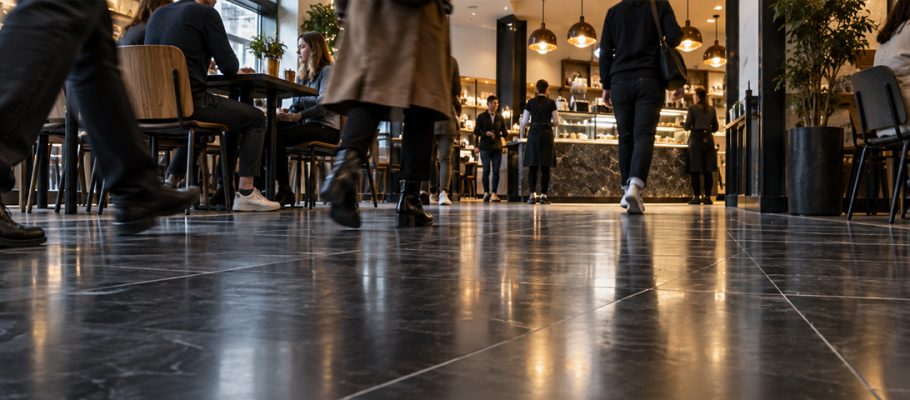
Yes, porcelain tile is one of the more durable flooring materials available for commercial and residential use. It’s classified as impervious under industry standards, with a water absorption rate of 0.5% or less, and commonly carries a PEI rating of 4 or 5, the surface wear scale used across the tile industry.
But “durable” isn’t one property, it’s several: how well it resists moisture, scratching, cracking, and everyday wear. This guide breaks each of those down individually, with the actual standards behind them, so you know what you’re really specifying before a project moves forward.
Key Takeaways
- Porcelain has a water absorption rate of 0.5% or less, classified as impervious under ASTM C373.
- Porcelain commonly carries a PEI rating of 4 or 5, a wear-resistance scale that runs from 0 to 5.
- Breaking strength is tested under ASTM C648, and porcelain must meet a higher minimum than more porous tile classifications under ANSI A137.1.
- Porcelain resists staining well when properly installed, but grout and glaze condition still matter.
- Not all porcelain performs identically; PEI rating, breaking strength, and finish vary by product.
- Durability depends on the specific product and correct installation, not the porcelain label alone.
Is Porcelain Tile Durable? Summary
Below is a quick reference for the standards and figures that actually define porcelain’s durability.
| Property | Standard | Typical Porcelain Rating | What It Means |
|---|---|---|---|
| Water Absorption | ASTM C373 | 0.5% or less (impervious) | Resists moisture penetration into the tile body |
| Surface Wear (PEI) | PEI Scale (0-5) | PEI 4 to 5 | Suited to heavy and extra-heavy foot traffic |
| Breaking Strength | ASTM C648 | Higher minimum than semi-vitreous/non-vitreous tile per ANSI A137.1 | Resists cracking under impact or point load |
| Density | N/A | 2.3 to 2.5 g/cm³ (approximately 144 to 156 lb/ft³) | Denser body resists chipping and wear |
Is Porcelain Porous?
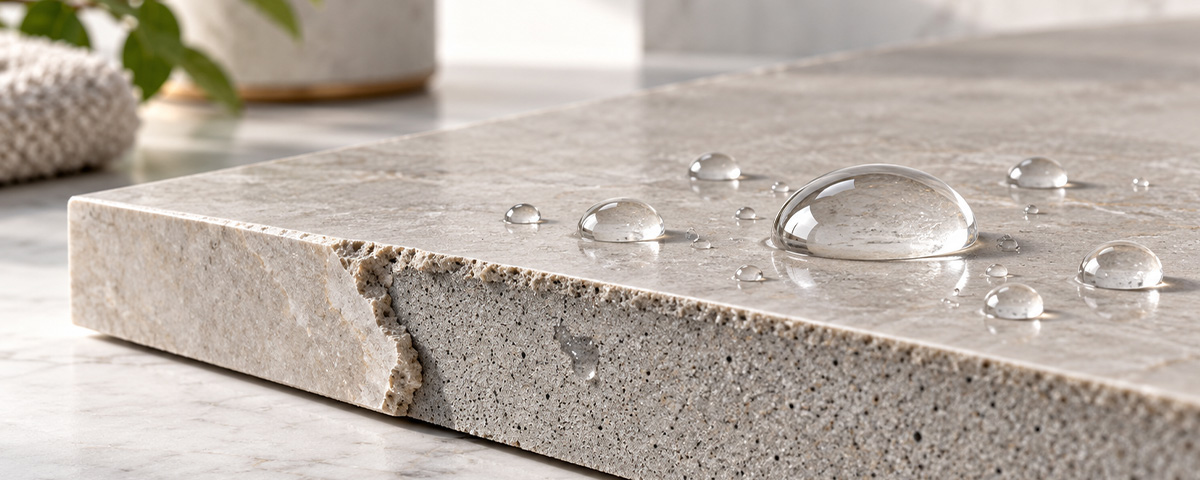
Not really. Porcelain’s water absorption rate is 0.5% or less of its weight in water, which earns it the “impervious” classification under industry standards, the lowest-absorption category a tile can carry. That low porosity is the foundation for most of porcelain’s other durability advantages.
What is Tile’s Water Absorption Rate?
Water absorption is measured under ASTM C373 by comparing a tile’s dry weight with its weight after water exposure. The more weight the tile gains, the more water it has absorbed. Porcelain absorbs 0.5% or less, placing it in the impervious category. Vitreous tile absorbs more than 0.5% up to 3%, semi-vitreous tile more than 3% up to 7%, and non-vitreous tile more than 7%.
| WATER ABSORPTION CLASSIFICATION | WATER ABSORPTION RATE | WHAT IT MEANS |
|---|---|---|
| Impervious | 0.5% or less | Absorbs very little moisture. Common in porcelain tile and well suited to many moisture-prone commercial areas when the product is approved for the application. |
| Vitreous | More than 0.5% to 3% | Low water absorption. Can perform well in many commercial interiors, depending on the specific tile and location. |
| Semi-vitreous | More than 3% to 7% | Absorbs more moisture than vitreous tile. Better suited to areas where moisture exposure is limited and the product is rated for the intended use. |
| Non-vitreous | More than 7% | Highest water absorption category. Generally requires more careful placement in commercial spaces, especially where frequent moisture is present. |
If you are considering porcelain tile, the practical takeaway is simple: the lower the absorption rate, the less readily the tile body takes in moisture. That can make impervious porcelain a strong choice for restrooms, entrances, kitchen areas, and other spaces where spills or moisture are common. Traffic level, slip resistance, and whether the tile is approved for exterior use should still be evaluated separately.
Stain Resistance
Porcelain absorbs very little moisture, so spills, oil, and dirt are less likely to soak in. On glazed porcelain, the surface glaze does most of the work when it comes to resisting everyday stains.
The bigger advantage shows up if the glaze chips or wears down. Since the porcelain underneath is still dense and low-absorption, a chip doesn’t necessarily mean the tile will soak up stains, as it does with regular ceramic tile.
Does Porcelain Need Sealing?
Most porcelain tile does not need to be sealed the way natural stone does because it is dense, non-porous, and inherently resistant to water and stains.
Polished porcelain is a bit different. Polishing can open tiny pores at the surface, so some manufacturers recommend using a penetrating sealer before grouting. That can help reduce staining and make grout cleanup easier.
Honed porcelain typically has a smooth, matte surface and is dense enough to resist everyday moisture and staining without additional sealing. However, finishes can vary by product, so always check the manufacturer’s care and maintenance recommendations before deciding whether a sealer is needed.
How Is Porcelain Tile Made
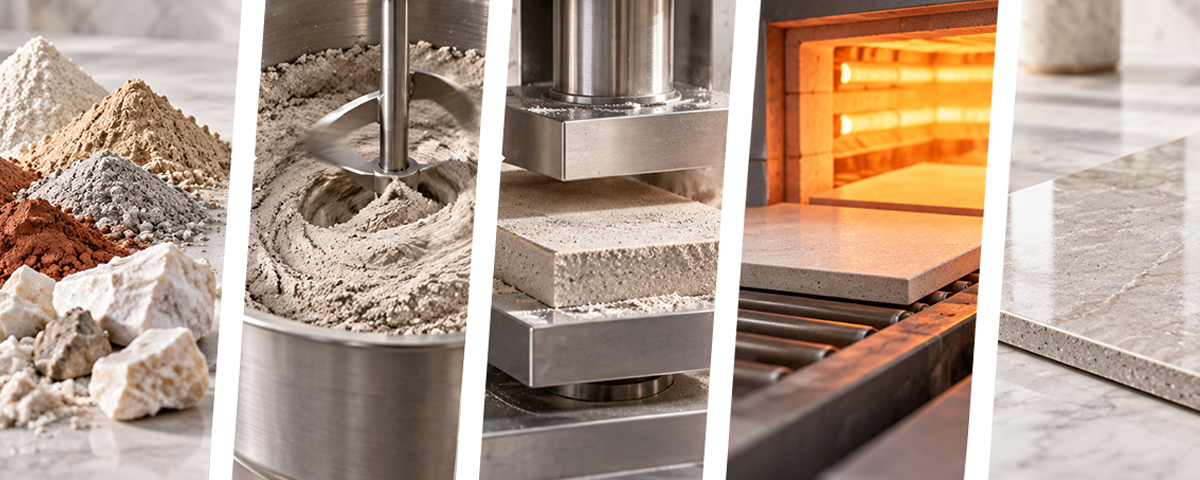
Porcelain tile starts as a blend of finely ground clay and mineral raw materials, pressed under high pressure, then fired in a kiln until the material fully vitrifies, fusing into a dense, glass-like structure with very little internal porosity. That manufacturing process is what produces porcelain’s defining water absorption rate of 0.5% or less.
Material Differences: Porcelain vs. Standard Clay Bodies
Porcelain: Made with finer, more refined clays, including kaolin, fired at a higher kiln temperature, typically 2,200°F to 2,500°F (1,200°C to 1,370°C). The result is a denser, less porous tile body.
Standard ceramic: Made with coarser, more common clays, fired at a lower temperature, typically 1,650°F to 2,000°F (900°C to 1,100°C). The lower firing temperature and coarser clay produce a less dense, more porous tile body.
Porcelain Hardness and Scratch Resistance
How well a floor resists scratches really comes down to two things: is the tile glazed or unglazed, and what’s its tested wear rating? We’ll get to that rating in a second.
But porcelain does have a real hardness edge on its own, thanks to its density. You’ll often see this measured on the Mohs scale, the same scale used to rank the hardness of minerals, where porcelain typically lands around 6 to 7. That’s harder than most things that would normally scratch a floor.
However, there’s one thing to keep in mind: Mohs isn’t an official tile industry rating. You won’t find it on a manufacturer’s spec sheet next to water absorption or PEI class. It also measures something different: a single scratch, not years of foot traffic wearing down a surface. For that, the tile industry uses its own real standard, called Visible Abrasion Classification, which we’ll break down next.

PEI Rating Porcelain Tile
The PEI rating is a 0-to-5 scale that measures how well a tile’s glazed surface holds up to everyday foot traffic, the higher the number, the more traffic the tile is built to handle. Porcelain commercial products commonly fall into Class 4 (suitable for medium commercial and all residential use) or Class 5 (suitable for intense commercial and all residential use).
Pro Insight: “PEI” isn’t actually the correct term for this rating. Per the Tile Council of North America, the official designation under ANSI A137.1 is Visible Abrasion Classification, tested under ASTM C1027. “PEI” traces back to the Porcelain Enamel Institute, founded in 1930 to represent manufacturers of porcelain enamel, a glass coating fused to metal used on products like sinks, bathtubs, and appliances, not ceramic tile. The name simply stuck in common industry usage over time.
How ANSI A137.1 and Visible Abrasion Classification Relate
Visible Abrasion Classification is just one section within a much larger standard. ANSI A137.1 governs ceramic, porcelain, and quarry tile performance broadly, covering water absorption, breaking strength, chemical resistance, coefficient of friction, and abrasion resistance all in one document.
How Tile’s Wear Resistance Is Measured
Wear testing depends on whether the tile is glazed or unglazed; they’re not tested the same way.
For glazed tiles, a rotating abrasive load is run across the surface, then visually compared to an unabraded sample to find the point where wear first becomes visible. Results are classified 0 to 5 under ANSI A137.1:
| PEI RATING (CLASS) | REVOLUTIONS TESTED | MAXIMUM RECOMMENDED USE |
|---|---|---|
| 0 | Fails before 100 | Not recommended for floors |
| 1 | Up to 150 | Light residential |
| 2 | Up to 600 | Residential |
| 3 | Up to 1,500 | Heavy residential or light commercial |
| 4 | 2,100 or more | Commercial |
| 5 | 12,000 or more, plus passes a chemical stain resistance test | Heavy commercial |
Class 5 isn’t just about revolution count; a tile also has to pass a chemical staining resistance test to qualify, which is part of why it’s reserved for the most demanding commercial and industrial applications.
For unglazed and full-body porcelain, where color runs through the entire tile, this test doesn’t apply. Instead, it’s tested under ASTM C1243, Deep Abrasion Resistance: a rotating steel disc grinds against the surface with aluminum oxide abrasive for a fixed number of revolutions, and the size of the resulting wear groove is measured and converted into a volume of material lost, reported in cubic millimeters (mm³). Lower numbers mean better wear resistance. Commercial-grade unglazed porcelain commonly tests below 175 mm³.
Is Porcelain Tile Heat Resistant?
Yes, porcelain tile is highly heat-resistant. Porcelain is fired at extremely high temperatures (typically around 2,100°F to 2,500°F), far exceeding anything it will encounter in daily use, direct sunlight, hot cookware set down briefly, a hearth surround near a fireplace, or a heated patio surface, so none of that poses a real risk to the tile itself.
It is easy to assume porcelain handles heat better because it is fired at a higher temperature. In practice, that firing temperature mainly affects how the tile is made. Once installed, both porcelain and ceramic handle normal everyday heat well.
Where it gets more specific is sustained, direct heat, radiant floor heating or tile installed near a fireplace or wood stove. In those cases, the tile isn’t usually the limiting factor, the mortar underneath is. Standard thinset can break down under prolonged high heat, which is why some manufacturers offer heat-rated mortar formulations for these applications, with rapid-setting tile mortar recommended for walls and floors adjacent to fireplaces and wood stoves. Always confirm the specific product, adhesive, and grout are all manufacturer-rated for the intended heat exposure, not just the tile itself.
Sudden temperature swings are a separate issue from sustained heat, covered under Thermal Shock below.
How Strong Is Porcelain?
Porcelain is a very strong and durable material, but it is also brittle. It can handle substantial everyday loads and wear, yet a sharp, heavy impact can still chip or fracture the tile.
Porcelain must meet a minimum breaking strength of 250 lbf under ASTM C648, tested via a three-point bend test that measures how much force a tile can withstand before fracturing. Many commercial-grade porcelain products test well above that minimum, some manufacturers specify 300 lbf or higher, since it’s a stronger indicator of real-world impact and load resistance than density alone.
PEI, or Visible Abrasion Classification, measures how the surface wears with use. Breaking strength is about how much force the tile itself can take before it fails. That becomes more important in commercial spaces where heavy furniture, equipment, or concentrated loads put extra pressure on the floor.
Is Porcelain Fragile?
Porcelain tile is not fragile under normal use, but it is brittle. Properly installed porcelain is strong and durable enough for demanding residential and commercial spaces, although sharp impacts or inadequate support beneath the tile can still cause chips or cracks.
Confusion here usually comes from porcelain dinnerware, which is thin and genuinely delicate; floor and wall porcelain tile is a completely different product, denser and manufactured for structural performance, not fine tableware.
Common Causes of Breakage
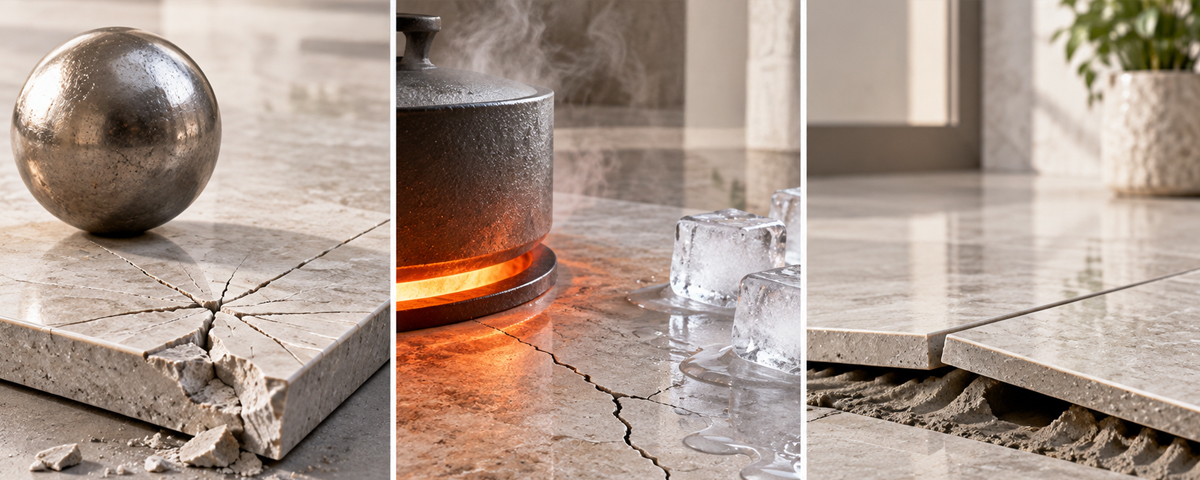
Porcelain tile can still break, but it’s rarely the material itself failing on its own. The most common causes:
Impact
A heavy object dropped directly onto the tile, particularly on an edge or corner, where force concentrates rather than spreading across the surface.
Thermal shock
A rapid, extreme temperature change rather than gradual heat exposure. This is a different mechanism from the everyday heat resistance covered above; it’s the speed of the change, not the temperature itself, that creates the risk.
Poor installation
Inadequate mortar coverage, an unprepared or moving substrate, or the wrong product for the application. This is the most common real-world cause and the one most within a contractor’s control.
Does Porcelain Tile Crack Easily?
No, porcelain tile does not break easily under normal conditions, especially when it is properly installed. Porcelain’s breaking strength, as tested under ASTM C648, and its density both help prevent cracking under normal use. Where cracking actually happens, it’s almost always traceable to one of the causes above, most often a substrate or installation issue rather than the tile itself giving out. A crack that appears soon after installation is a strong signal to check the installation, not the product.
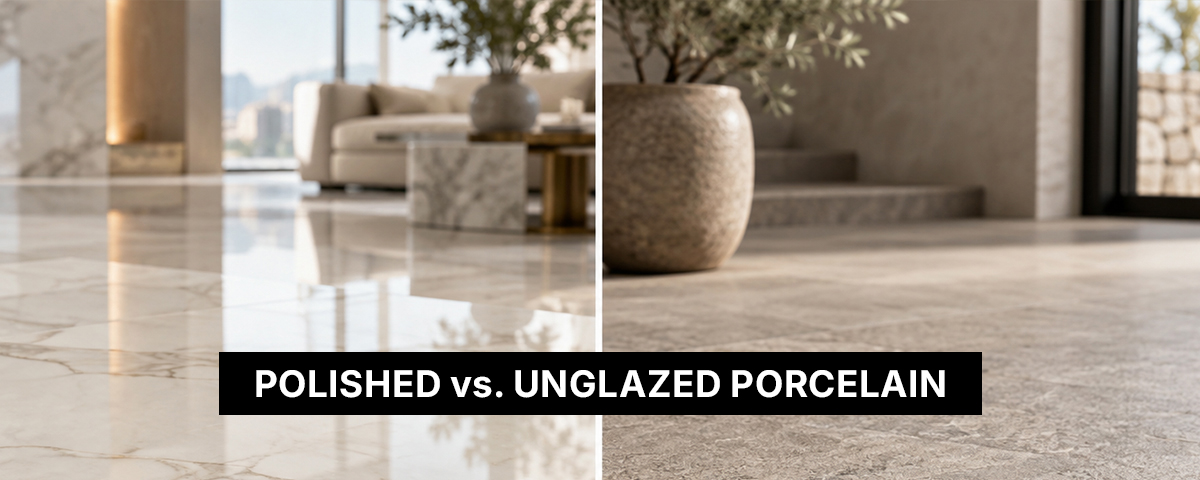
Polished vs. Unglazed Porcelain
Not every porcelain finish behaves the same way. Here’s what changes when you move from a standard glazed tile to polished or unglazed porcelain.
Polished Porcelain and Visible Wear
Polished porcelain is not necessarily less durable, but it can make everyday wear easier to see. The polishing process creates a smooth, reflective surface, so scratches, footprints, and light scuffs tend to stand out more under direct light than they would on a matte or textured tile.
That difference is mostly about appearance. The tile underneath can still have the same strength and wear rating as other finishes in the same product line, but the polished surface is less forgiving when small marks start to show.
Unglazed vs. Glazed Porcelain
Glazed porcelain has a glass-like coating fired onto the surface. That layer helps resist stains and is the part evaluated for visible surface wear.
Unglazed and full-body porcelain do not have that separate coating. The color and material run through the tile, so scratches and small chips tend to blend in better. Their wear resistance is also tested differently, using ASTM C1243 instead of the glazed-tile abrasion method.
Porcelain Tile Flooring Durability in Real-World Use
All the individual properties covered so far, water absorption, hardness, breaking strength, add up to how a porcelain floor actually performs over years of real use, not just on a spec sheet.
Take a resort bathroom at Evermore Flats in Lake Buena Vista. IFI installed porcelain tile on both the floors and walls as part of a much larger project, with 145,900 square feet of wall tile and 171,930 square feet of flooring across three five-story buildings.
Those bathrooms deal with moisture, frequent guest turnover, and daily cleaning. At that scale, the tile has to hold up and look consistent from one room to the next. That is where product specs start to matter in the real world.
What Is the Lifespan of Porcelain Tile?
Porcelain typically falls in the 50-year-or-more range, with quality ceramic landing around 20 to 30 years, a typical range reported across the industry. Actual service life depends heavily on installation quality, substrate condition, and maintenance, which is why that range varies.
Here’s an interesting fact: the Tile Council of North America actually assumes ceramic tile lasts 75 years, on the theory that a tile floor typically only gets replaced when the whole building needs remodeling, not because it wears out. In the real world, most floors get a facelift long before that a remodel, a style change, new ownership), well before the tile itself would ever fail.
However, there’s one part of the system that wears out well before the tile does, and it’s not something most people think about: the grout. Cement grout typically needs repair or replacement every 8 to 15 years, sooner in wet or heavily trafficked areas, regardless of how well the porcelain itself is holding up. A porcelain floor can easily outlast two or three rounds of regrouting over its lifetime.
Porcelain Durability FAQ’s
If you have questions, here are some answers to the questions we hear most often about porcelain’s durability.
Is Porcelain Tile Durable?
Yes. Porcelain tile is a highly durable flooring material with very low water absorption, strong resistance to everyday wear, and minimum breaking-strength requirements under ANSI A137.1. Many commercial porcelain tiles also carry high visible abrasion classifications, making them well suited for busy spaces when the product is properly selected and installed.
Is Porcelain Tile Waterproof?
Porcelain tile is considered impervious rather than waterproof. Porcelain has a very low water absorption rate of 0.5% or less, meaning the tile body absorbs very little moisture, though it is not zero. In practice, porcelain performs essentially like a waterproof surface for everyday use, but “impervious” is the accurate term, not “waterproof.”
Does Porcelain Tile Scratch Easily?
No. Porcelain’s density gives it real resistance to scratching, commonly measured around 6 to 7 on the Mohs hardness scale. Polished finishes show light marks more visibly than matte or textured ones, but that’s a cosmetic difference in how wear appears, not a difference in the tile’s actual durability.
Will Sanded Grout Scratch Porcelain Tile?
It can, on certain finishes. Sanded grout contains fine sand particles that can create micro-scratches on polished or highly reflective porcelain if it’s not applied and cleaned carefully. Matte, textured, and unglazed porcelain are much less affected. Many installers use unsanded grout on polished porcelain specifically to avoid this risk, check the tile manufacturer’s grout recommendation before starting a job.
Is Porcelain Tile Durable Enough for Commercial Use?
Yes, when the right product is specified. Commercial-grade porcelain is commonly rated PEI 4 or 5 (officially called Visible Abrasion Classification) for heavy foot traffic, and it still has to meet the same ANSI A137.1 breaking strength minimum as any other porcelain. Not every porcelain product is built for commercial demands, though; always confirm the specific wear rating before specifying it for a high-traffic project.
Can Cracked or Chipped Porcelain Tile Be Repaired?
Small chips are often repairable, especially on through-body porcelain, where the color runs all the way through, so a color-matched filler blends in far better than it would on a glazed tile. Cracks are a different story. A crack usually means something moved underneath the tile, so replacing just the tile without addressing the substrate issue often means the crack comes back.
Do All Porcelain Tiles Have the Same Durability?
No, porcelain tiles can vary significantly in durability. Strength, scratch resistance, and surface wear depend on factors such as manufacturing quality, thickness, composition, and finish. Visible Abrasion Classification, breaking strength, and other performance ratings also vary by product, so always check the manufacturer’s technical data rather than relying on the porcelain label alone.
Conclusion
Porcelain earns its reputation for durability, but not from any single property. Its low water absorption, density, hardness, and breaking strength each play a role, and together they explain why it holds up in demanding commercial spaces when the right product is specified and properly installed. Where porcelain underperforms, it’s rarely the material itself; it’s almost always a mismatch between the product and its application, or an installation issue like inadequate mortar coverage or a moving substrate.
If you’re specifying porcelain for a commercial project, matching the product’s PEI rating, breaking strength, and finish to the actual demands of the space is what determines whether it performs for decades or needs attention within a few years. Curious how porcelain compares to ceramic for your specific project? Our guide, Porcelain vs. Ceramic Tile: What’s the Difference & Which Should You Choose, breaks down the full comparison.
Partner with an NTCA Five-Star Accredited Contractor for your next commercial project
As an NTCA Five-Star Accredited Contractor, IFI specifies and installs porcelain tile for hospitality, healthcare, and commercial projects throughout Central Florida, where getting the product and the installation right the first time matters most. Request a free, no-obligation estimate by filling out our contact form or calling (407) 296-7465.
References
ANSI Standards for Ceramic Tile (A108, A137.1, A137.3) — Tile Council of North America
https://tcnatile.com/resource-center/ansi-standards/
ASTM C373 & C648: Water Absorption and Breaking Strength, applied to a real porcelain product — Daltile Technical Sales Sheet, Haut Monde Collection
https://digitalassets.daltile.com/content/dam/Daltile/website/resources/products/sales-sheets/haut-monde/DAL_StoneAttache_HautMonde_SS.pdf
ASTM C1027 and Possible Upcoming Changes (Visible Abrasion Classification vs. “PEI Rating”) — Tile Council of North America https://tcnatile.com/wp-content/uploads/2022/08/Tile-Abrasion-ASTM-C1027-and-Possible-Upcoming-Changes.pdf
Environmental Product Declaration for Ceramic Tile (Reference Service Life) — Tile Council of North America https://proflex.us/wp-content/uploads/2026/06/TCNA-EPD-101.2_Tile-Council-of-North-America_EPD_Ceramic-Tile-exte.pdf